Request a Quote

Science & Ingredients

Understanding the ingredient.

Plain, sourced explanations of what our ingredients are and how they are used. Educational content, not health advice.

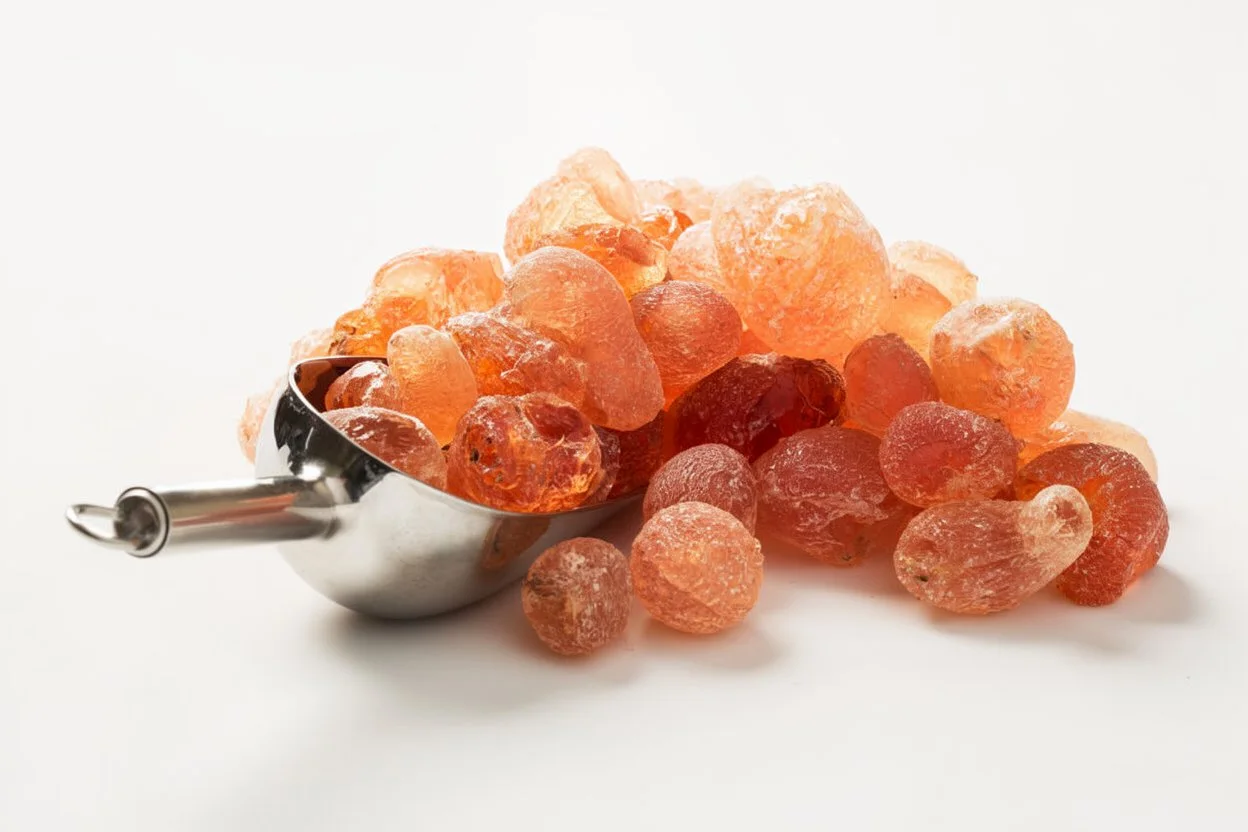
Raw gum arabic tears beside a stainless steel scoop
Raw gum arabic

The basics

Gum arabic in three lines

  • What it is

    Gum arabic (also called acacia gum) is the dried gum that exudes from the stems and branches of certain acacia species.

  • How it is used

    In food and drink it is used to stabilise, emulsify and thicken. In the European Union it is listed as food additive E 414.

  • What it is made of

    It is mostly a complex carbohydrate (a polysaccharide) with a small protein fraction. Exact composition varies by species and source.

  • Beverages

    Gum arabic dissolves readily in water and gives fairly thin solutions, which is why it is widely used to keep flavour oils evenly dispersed in drinks and beverage bases.

  • Confectionery

    It is a traditional ingredient of pastilles, gums, hard and soft candy and sugar coatings, where it helps give texture and a glossy finish.

  • Bakery, glazes and toppings

    It is used in glazes, frostings and toppings to help them set evenly and hold their shine.

  • Dairy alternatives, desserts and snacks

    US rules list it for dairy product analogs, fats and oils, gelatins, puddings and fillings, frozen confections, nut products and snack foods.

Recognised functions in food: Emulsifier, Stabiliser, Thickener, Flavouring adjuvant, Formulation aid, Humectant, Surface-finishing agent. US rules (21 CFR 184.1330) set a maximum level for each food category.

These are general uses of the ingredient. Ask for preparation guidance for a CAZOTERA product when you request a quotation.
  • Pharmaceutical and cosmetic preparations

    FAO lists pharmaceutical and cosmetic preparations among the main non-food applications of gum arabic.

  • Lithographic and offset printing

    Gum arabic is used in lithographic and offset preparations.

  • Paper, textiles and adhesives

    Small quantities are still used in paper making. Its former uses as an adhesive and as a textile sizing and finishing material have largely given way to synthetic substitutes.

Industrial buyers should confirm the grade and specification needed for their process when they request a quotation.

Raw gum arabic is the dried gum as collected: hard, amber pieces known as tears. Before use it is cleaned and sorted, then either ground into a powder or dissolved, filtered and spray-dried. The international JECFA specification sets limits for both granular and spray-dried gum, including loss on drying, ash, insoluble matter, lead and microbiological criteria.

The FAO/WHO Joint Expert Committee on Food Additives (JECFA) has evaluated gum arabic as a food additive and allocated an acceptable daily intake “not specified”.

Gum arabic is also studied in nutrition research. In the European Union and many other markets a health claim on a food must be authorised before it is used, so this website makes no health claim for any CAZOTERA product.